Faro History and Its Place in American Gambling
Faro history connects the card game's European roots with American gambling and offers a clear method for judging claims about its reputation and decline.
The most common mistake in Faro history is treating its reputation for dishonest dealing as proof that every table was crooked. Faro history is easier to assess when claims about the game’s American presence, reputation, and retreat are tied to a particular place and source.
Faro history needs place-specific evidence
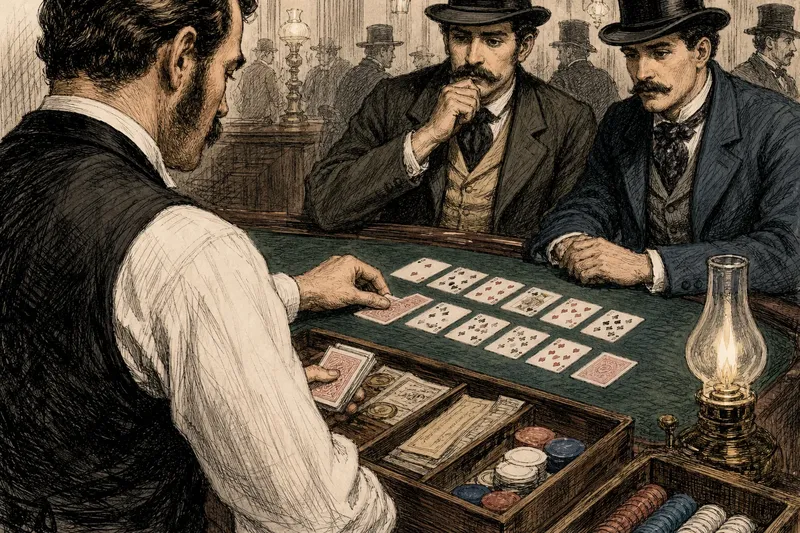
Faro, also spelled Pharo or Pharaoh, was a banking card game with European roots. Players wagered on card values, while a banker managed the deal and took the opposing position. That basic description explains the game’s structure, but it cannot establish when Faro arrived in a particular American city or how common it became there.
The original account offers no citations for its broad statements about Faro’s prominence or decline. Treat those claims as provisional rather than established facts. A source tied to a named venue, city, or period is needed to support a more precise history.
Separate the kinds of claims before repeating them. A rules description tells readers how play worked; a dated account may document a venue; an interpretation explains what the game meant to people. Each claim needs evidence suited to it.
Banker control shaped Faro’s public image
Because the banker handled the deal, players had reason to care about whether the rules were followed. Accounts that associate Faro with marked cards or manipulated play can help explain its reputation, but an accusation alone does not show that a particular banker cheated.
Keep an allegation, the evidence offered for it, and a broader judgment about the game distinct. It is like separating a rumor about a shop from a dated record of a transaction: the rumor belongs to the shop’s public image, but it cannot establish what happened at the counter.
To describe a specific alleged incident, identify who made the claim, where and when it was said to occur, and what evidence the account provides. If those details are missing, describe the claim as unverified or omit it.
Claims about Faro’s retreat need a defined scope
The original article says Faro eventually gave way to other games, but it does not cite evidence or establish a universal timeline. A careful account should name the place and period under discussion and identify the alternatives involved, if the evidence supports that detail.
Changing tastes and competition from other games may be useful interpretations, but they should not be presented as proven causes without supporting accounts. Avoid attributing a broad decline to one scandal unless a source connects that incident to a documented change in specific venues.
What should readers ask about Faro history?
What does “banking game” mean?
A banker manages the deal and takes the opposing position to players’ wagers. The term describes the game’s structure, not whether a particular deal was fair.
Did Faro originate in the United States?
The available account describes Faro as having European roots before its American presence. To establish a more exact origin or route of spread, consult sources that document those claims.
Does Faro’s reputation prove a table was rigged?
No. A general reputation or an accusation does not establish what happened at a specific table. Look for evidence tied to the incident and attribute claims to the source that made them.
Why did Faro lose ground?
The original account attributes its retreat broadly to changing tastes and competition, without providing citations. Treat that as an interpretation unless a place-specific source supports the explanation.
Check each Faro claim before repeating it
- Rules: Check whether the account explains the wager, the banker’s role, and how cards determined the result. If it does, use it for those details; if it does not, find a rules source or leave the mechanics unspecified.
- Dates: Check whether the date is tied to a named place or document. If it is, limit the date to that context; if it is not, avoid presenting it as a universal milestone.
- Allegations: Check whether the source names who made the claim and what evidence was offered. If it does, attribute the allegation; if it does not, label it unverified or leave it out.
- Popularity: Check whether a source defines popularity through a named venue, record, or period. If it does, keep the claim within that scope; if it does not, avoid broad claims about American prominence.
- Decline: Check whether the account identifies a place, period, and competing games. If it does, describe the change within those bounds; if it does not, say only that the source does not establish a precise retreat.
- Social meaning: Check whether an interpretation is linked to specific accounts or circumstances. If it is, present it as an interpretation; if it is not, separate it from documented details about play.
Say you encounter an invented passage claiming that Faro vanished from every American gambling room after one cheating scandal. Its starting information is only that sweeping claim; it gives no source, place, or date. First, mark the statement as unsupported because it asserts both a cause and a nationwide outcome. Next, look for an account that identifies the alleged scandal and names the venues it affected. If no such account is available, do not repeat the claim as fact; report only that this passage does not establish when or why Faro lost ground.
Keep Faro history within the evidence
Faro’s rules, reputation, American presence, and retreat are separate subjects, not proof of one another. The available account describes a European-rooted banking game and broad claims about its American history, but supplies no citations to verify the claimed prominence or decline.
When discussing Faro history, name the evidence behind a specific date, venue, or allegation. If the source does not provide those details, narrow the claim and make the uncertainty clear; readers can then distinguish what the account says from what it actually supports.