Why Roulette Bets Sit Inside or Outside the Layout
Roulette bets inside or outside the layout name different features of the wheel. Learn how chip placement identifies a number, group, or category.
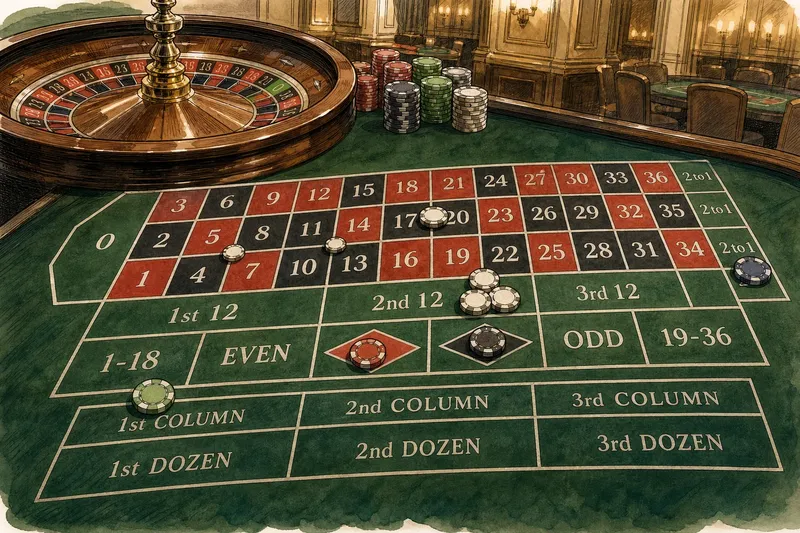
The most common roulette-layout mistake is reading the felt as one flat menu and placing a chip before checking what its position means. Roulette bets inside or outside the layout refer to different kinds of selections: a specific number or small group, or a broader category. Confusing those areas can leave you unsure what your chip identifies.
The numbered grid maps pockets into rows and columns. Labels around it name groups and features. Read each as a distinct kind of mark, not as a prediction of where the ball will land.
Inside bets identify numbers and compact groups
Inside bets sit on the numbered portion of the layout. “Inside” describes where the bet appears on the felt, not a separate part of the wheel.
A chip centered in a number’s box identifies that number. A chip on a shared line or corner identifies the numbers that meet there. Common inside placements include:
- Straight-up: One number, marked in its box. If the chip is clearly within that box, it identifies the printed number; if it falls across a boundary, ask the dealer to clarify.
- Split: Two neighboring numbers, marked on their shared boundary. If the chip sits on the line, it identifies that pair; if its position is unclear, ask before the spin.
- Street: A row of three numbers, marked along the row’s outer edge. If the chip is on that edge, it identifies the row; if it is inside one box, it identifies that number instead.
- Corner: Four numbers meeting at one point, marked at their shared intersection. If the chip is on that intersection, it identifies the group; if the spot is ambiguous, ask the dealer.
- Line or double street: Two adjoining rows, marked along their shared boundary. If the chip is placed on that boundary, it identifies both rows; if the layout’s placement convention is unclear, check the table rules.
These names describe the area covered by a placement. They do not alter the printed numbers or indicate where the ball will land. Think of the grid as a street map: a mark on one address identifies less territory than a mark covering several adjacent addresses.
Outside bets identify broad features
Outside bets sit in labeled areas beyond the numbered grid. They identify a shared feature or grouping rather than one exact box. Depending on the layout, labels may cover red or black, odd or even, low or high numbers, columns, or dozens.
Color labels group numbers by the colors printed on the felt. Odd and even divide eligible numbers by their numerical character; low and high divide them into ranges. Column and dozen labels point to recurring groupings across the grid.
Zero and double zero need special attention. They do not fit every outside category, and a layout may show them apart from color, parity, or range labels. Read the table’s printed rules to see how it treats these pockets rather than assuming every broad category includes them.
“Outside” refers to the bet’s position on the felt, not a location on the physical wheel. A color box beyond the grid still names pockets on the wheel; it simply groups them by a shared feature.
Chip placement communicates the selection
The layout works as a communication system. A dealer reads a chip’s position to identify the selection, so placement matters even when the label seems familiar.
On the grid, a chip in a number, on a shared line, or at a corner communicates a different choice. In an outside area, the printed label names the category. Keep the chip within the intended space, and ask the dealer if the placement is uncertain.
Say you want to identify the three numbers in one row. You place a chip along that row’s outside boundary, and the visible result is a street selection rather than a single-number selection. If you instead place it clearly inside one number’s box, the marker identifies that number. The chip’s position supplies the meaning.
The wheel and the felt arrange numbers differently
The wheel places pockets around a circular track. The felt rearranges the numbers into a grid, then adds labels for groups that cross that grid. These are two views of the same game, but they serve different purposes.
The grid makes numbers and their boundaries easy to read. Outside labels group numbers without requiring a player to mark each one separately. The felt is a working diagram for identifying selections, not a picture of the wheel’s physical order.
That distinction matters because numbers beside each other on the grid are not necessarily neighbors on the wheel. The layout prioritizes clear placement; the wheel follows its own sequence.
Read an unfamiliar layout from the numbers outward
Use this routine to identify what a placement means before acting:
- Locate the numbered grid and zero area. If both are visible, move on to the labels; if the layout is hard to read, ask the dealer to point them out.
- Find the category labels. If you can identify color, parity, range, column, or dozen areas, note where they sit; if a label is unfamiliar, ask what it covers.
- Inspect the chip’s position. If it is inside a number, on a boundary, or in a labeled box, use that position to identify the selection; if it straddles spaces, ask for clarification.
- Name what the position covers. If it marks one number, a compact group, or a broad category, distinguish that selection before proceeding; if you cannot name it, pause and ask.
- Check the treatment of zero and double zero. If the printed rules explain their status, follow those rules; if they do not, ask the dealer rather than assuming they belong to a category.
- Confirm any table-specific placement convention. If the dealer confirms the spot’s meaning, proceed with that understanding; if not, wait until the placement is clear.
This routine separates two questions: where the chip sits and what that position represents. The felt answers the first; its number, boundary, or label answers the second.
What do common roulette layout questions mean?
How can you tell an inside bet from an outside bet?
A placement on a number or its shared boundary is inside. A placement in a labeled category area beyond the grid is outside.
What does a chip on a line mean?
It identifies the numbers that share that boundary; a chip at a corner identifies the numbers meeting there. If the location is not clear, ask the dealer how that table reads it.
Does the layout show the wheel’s pocket order?
No. The felt arranges numbers into a grid, while the wheel places pockets around a circular track. Grid neighbors are not necessarily wheel neighbors.
Why are zero and double zero shown separately?
They are special pockets that do not fit every outside grouping in the same way as numbered boxes. Check the printed rules for how they relate to the table’s categories.
Use the labels to identify bets, not predict results
Inside and outside describe where a selection appears and what it covers. Inside placements identify particular numbers or compact groups; outside labels identify broader categories. Neither tells you what the next result will be.
When you approach a table, start at the numbered grid, notice the special pockets, then read the surrounding labels. That is the simplest way to understand roulette bets inside or outside the layout: the felt records a selection, not a forecast.